Wednesday, February 24, 2010
Jewish American seeks justice for Palestinians New book encourages shift in interfaith dialogue to reach peace in the Holy Land
Saturday, February 13, 2010
Mornings in Jenin: a novel by Susan Abulhawa
I have read almost every book published on the Arab-Israeli conflict. In part, I've read them all because I live in the United States where, as a Palestinian, I hunger for the truth about the Arab Israeli conflict. Here in the United States, the book publishing industry has been biased. Those few books that manage to make it into print under small usually left-wing book labels, have never satisfied my contempt for the bias in this country.
I've read all the books -- or, maybe to be more precise, I have tried to read all of them and have read most -- also because I continue to look for the Palestinian version of "Exodus," the propaganda novel penned by Leon Uris at the urging of a publicist hired by the Israeli government that recognized the power of compelling literature, something that has for far too long been missing from Arab literature in English.
Exodus was the benchmark of American understanding of Palestine, a story of poor victims of the Holocaust (victimized not by Arabs but by European Nazis and anti-Semitic Western countries like the United States). It told a great story even though much of it was false.
A lifetime of searching for one book that might have a shot at grabbing the heartstrings of American audiences in the same way that Uris' compelling and well-written propaganda moved Americans to embrace injustice against Christian and Muslim Arabs in Palestine, the original homeland of Christianity.
I may have finally found that book, although after a half century of seeking, I may not be able to stop myself from continuing a hunt for the perfect Palestinian literary novel that has become my second avocation in life. That book is "Mornings in Jenin."
"Mornings in Jenin" has everything I have found in Exodus and that has been missing in most literature written by Arabs about the tragedy of Palestine. Human compassion. A compelling human story. A believable narrative that is written not only from the perspective of a trouble Palestinian writer, and refugee from the second Nakba, 1967, but from the perspective of wanting to tell Americans and the West a story that by its nature would easily mesh into what Americans want.
I have always said in hundreds of speeches around the world that the real battle for justice in Palestine is not on some hate-driven web site or in an emotion-driven protest in the streets of Chicago or the Middle East, but in the pages of a book that is so compelling it will grab the heart strings of its readers. A book that is so compelling that the story rises above the politics and the message is delivered not with a sledgehammer, typical of most Palestinian and Arab narrative, but with a style and grace that flows like a creek through the American Dream.
Author Susan Abulhawa has written that book, one that takes the reader through a believable and captivating story of drama, tragedy and human life. For the first time, a palestinian has actually set aside the politics and with a literary finesse, has embedded that tragedy in the pages of an inspirational story that demands that you read it through the end, even if at times it challenges the stereotypes and false notions that have been spoon fed by a propaganda machine and a media bias in America and the West.
The 330 pages is more importantly an easy read. It flows with cries that force you to want to finish the book, and distracts you from the hot buttons that are ingrained in Western brainwashing that they can't even think for themselves.
This is the book I hope one day is made into a movie. The book that Americans can easily pack away in their luggage and carry with them to the battlefield for the minds and hearts of the Palestine-Israel conflict, vacation beaches where more novels that have damaged the Arab image have been absorbed and swallowed and believed by hundreds of millions of Americans who have never had their false notions and beliefs challenged by truth. I always run in to tourists readings books like Exodus that tell the Israeli story or cast Arabs as the villain. But I have never come across one tourist carrying the great literary political works by Edward Said, Ibrahim Abu-Lughod, my mentor in Palestinian identity, nor any of the other thousands of authors who have told and retold the tragedy of Palestine in the same clinically boring politics and academic rhetoric that has rendered or heart wrenching story into one that could so easily be brushed aside. That is not to say that Edward Said is not one of our great writers. But his writings have never appealed to the masses of Western audiences, an audience we as Arabs have failed to properly address.
Susan Abulhawa's novel will put its readers in a headlock they will not be able to escape until they finish every last word in this compelling drama taken from the pages of history and presented as a human story rather than some political argument or narrative.
This is the book I hope to one day see in the hands of tourists as they lazily lounge on the world's simmering beaches, absorbing truth in the ultimate moment of exposure to truth. This is the book I hope to one day watch on the big screen, in a theater filled with American audiences waiting for the next word.
Mornings in Jenin
Susan Abulhawa
Bloomsbury Books, New York
Paperback edition
2010
Formerly titled "The Scar of David."
end
Monday, December 21, 2009
It's Easier to Reach Heaven than the End of the Street; A Jerusalem Memoir
“This book must be one of the most honest accounts of those terrible years. It's proportionate, subtle and comprehensive… biased towards nobody but the voices of moderation and hope.” —The GuardianSaturday, October 24, 2009
The Arabs: A History by Middle East scholar Eugene Rogan
So much has been written about the history of the Arab World, most driven by interpretations of emotion, suffering and partisanship. Many of the books have been narratives reflecting the author's bias or political preferences, making them either easy to read satisfying your needs or difficult to read challenging your beliefs. Eugene Rogan, the director of The Middle east Centre at St. Anthony's College in Oxford, however, provides a clinically accurate and compelling "history" that gives the Arab World in a timely examination and explanation.
The introduction details why knowledge of the history of the Arabs is so important and it is followed by chapters that take you through the major developments and the evolution of today's Arab. How did they get to where they are at? And, are they being marginlized and erased by the growing Islamic revolution which is burying the richness and uniqueness of the secular Arab culture in a cult of religious bastardization? These are only some questions that one might answer in understanding the history of The Arabs in Rogan's book.
We all know the historical chronology, but Rogan takes us through a more interesting read through Ottoman rule, the Muhammad Ali empire, reformation, colonization in African, World War I, the disastrous rule of Britain in the Middle East, France in Lebanon, the disaster in Palestine, the rise of Arab nationalism, and the decline of Arab nationalism, the age of oil and the age of Islam, with a look at the consequences of the aftermath of the Cold War.
The other problem I have with past narratives of Arab history has been the writing. It's so hard to read some of the past historical collections. They are painful to the reader and intended for the scholar. Rogan's book mixes his firsthand experience living in the Middle East, his love for the Arab people and a writing style that encourages the non-scholar to appreciate and enjoy the rich cultural and political history of the Arabs. What the Arab World needs is less interference from the professors and scholars and more understanding among the public at large. The public needs this book more than the dusty shelves of some Middle East studies department or the classroom of affected PhD wannabes.
It's the ease by which one can read this thick scholarly work that makes it so valuable. Knowledge is worthless if it can't be expressed and passed along to the less knowledgeable. Rogan has taken the complexities of the Middle East and the role of its evolution under The Arabs and made it something everyday readers will enjoy. More importantly, they will take something away from this enjoyable reading experience. I've read almost every book on the Middle East and the Arabs over the past 35 years of American Arab activism, but Rogan's "The Arabs" has been the most enjoyable, and that makes it the most educational.
I am not a scholar on the Middle East, just a lifelong student. Reading through Rogan's book has been very informative and enjoyable. I highly recommend it.
More information on "The Arabs":
The Arabs
A Historyby Eugene Rogan
Hardcover
US $35.00
CAN $44.50
ISBN: 9780465071005
ISBN-10: 0465071007
Published by Basic Books
Description
Eugene Rogan
Eugene Rogan is a faculty fellow and university lecturer in the Modern History of the Middle East at St Antony’s College, Oxford, where he serves as director of the Middle East Centre. His previous book, Frontiers of the State in the Late Ottoman Empire, was judged by the Middle East Studies Association of North America to be the best work on the Middle East in 2000 and awarded the Albert Hourani Prize. He lives in Oxford, England.Tuesday, October 20, 2009
Maria Khoury: Book signing schedule for "Coloring with Christina" and "Witness in the Holy Land"
Friday, September 25, 2009
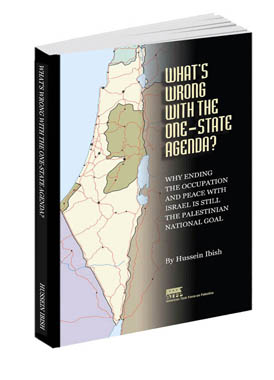
New Book by Hussein Ibish debunks myth of "one-state" agenda
Sunday, August 30, 2009
New Book: What's Wrong with the One State Agenda? by Hussein Ibish
ATFP presents a new Task Force book publication:
What’s Wrong with the One-State Agenda?
Why Ending the Occupation and Peace with Israel is Still the Palestinian National Goal
by ATFP Senior Fellow Hussein Ibish
In this new book, Dr. Ibish examines the arguments generally put forward by Palestinian and other Arab American proponents of abandoning the goal of ending the occupation and establishing a Palestinian state and instead seeking to promote a single, democratic state in all of Israel and the occupied Palestinian territories. The book also looks at differences between the deployment of the one-state idea by some Palestinian figures in the occupied territories as a diplomatic "threat" intended to spur greater Israeli seriousness about a negotiated agreement and the diasporic discourse that drives most one-state rhetoric. Finally, Dr. Ibish explains in some detail why ending the occupation and peace with Israel, while difficult to achieve and thus far elusive, are the only plausible and practicable Palestinian national strategy.
The book also includes a preface by ATFP President Ziad J. Asali.
Thursday, April 16, 2009
"Under the Cover of War" -- the Palestinian Nakba
Arabicus Books & Media presents an important new book.
Under the Cover of War
The Zionist Expulsion of the Palestinians
Rosemarie M. Esber
“Helps to balance documentation and diaries by one side . . . the suffering of those
who fled is all too evident.” -- Robert Fisk, The Independent
Ø Under the Cover of War explains in detail how the Jewish Agency used the cover of war to expel more than 400,000 Palestinian men, women and children from some 220 villages, towns, and cities before May 15, 1948 when the British relinquished the Palestine mandate and Israel became a state.
Ø Incorporates a Palestinian narrative of their expulsions by including some 130 new interviews with refugees from Jordan, Lebanon, and the United States.
Ø Provides an invaluable case study for U.S. military planners on how not to end a military occupation by describing how the scuttled British withdrawal from Palestine, in just six months, contributed to civil war and the creation of Palestinian refugees.
A MUST READ FOR THE MILITARY!
“I am more convinced than ever after reading this we need more attention to the problems in this region to have any kind of peace in the future.” -- Jerzee Devil
Watch the You Tube Trailer: http://youtube.com/watch?v=pUEq9GgS4F4
Robert Fisk, The Independent:
Under the Cover of War “helps to balance documentation and diaries by one side with verbal recollection on the other. The book does not spare the Arabs—least of all the Arab atrocities or the Iraqi volunteers who turned up to fight for Palestine but didn't even know their geography—yet the suffering of those who fled is all too evident.”
“Here for example, is Abu Mohamed from the village of Saqiya, east of Tel Aviv describing what happened on 25 April, 1948: ‘Jews entered the village and started shooting women, men, and old people. They arrested girls, and we still don't know what happened to them. They came from the settlement that was near the village. They used Bren guns. Then armoured vehicles entered the centre of the village. Fourteen were killed that day. Two women could not run so they were killed in the village. The villagers ran together in the direction of al-Lid (Lod, the site of Ben Gurion airport in Israel today). After that, families started to leave separately. We left everything in the village. We thought it would be a short trip and we would come back.’”
Publishers Weekly, web pick of the week 11/24/08:
In her first effort, researcher and writer Esber takes readers on a dramatic inquest of modern Israel’s beginnings and the Arab conflict over Palestine. Reviewing historical accounts, Esber reveals that after WWII many of Europe's expelled Jews sought to regain their roots in Palestine. This meant the expulsion of the Palestinian Arab community who lived there; with the tacit approval of the United Nations, Palestinians were cruelly evicted from their homes and lives, subject to demonization and, according to Esber, a campaign of ethnic cleansing. Esber’s account abounds with first hand accounts from Arab victims recounting the terror they faced at the hands of Zionist forces. This gripping historical account illuminates the plight of Palestinians following the War, too long overshadowed in the media and historical record by the atrocity of the Holocaust; placing them back to back, Esber demonstrates a tragic domino effect, in which victims become aggressors and survival becomes a matter of fighting back.
Order online from Amazon and Barnes & Noble
Under the Cover of War is an important resource for anyone seeking to understand the full story of the 1948 Palestine war and the roots of the Arab-Israeli conflict. Rosemarie Esber meticulously documents and poignantly recounts the first phase of the Zionist conquest of Palestine and the expulsion of the indigenous Palestinians—an estimated 84 percent were children under 15, pregnant and nursing mothers, the elderly, and the infirm.
As this compelling history shows, the human tragedy of Palestine’s ethnic cleansing entailed the demonization of the Palestinian Arabs, the incitement of violence by Jewish nationalist leaders, and a weak response from an apathetic international community. War provided a cover for systematic expulsions and the founding of the State of Israel on Palestinian land, while British colonial officials did little but watch.
An array of unpublished military and diplomatic sources supports the Palestinians’ own account of their Nakba (catastrophe or disaster), based on new, original refugee interviews. This little-known story of human suffering makes a convincing case that redressing Palestinian losses is vital for regional and world peace.
The author, Rosemarie M. Esber, Ph.D., is a researcher and writer with degrees from the University of London and The Johns Hopkins University.
For Immediate Release
ISBN: 978-0-9815131-7-1
Hardback, 440 pages, 40 illustrations, appendices,
bibliography, index, $29.95
Media Contact
Arabicus Books & Media, LLC
(703) 585-3463
arabicusbooks@aol.com
www.ArabicusBooks.com
Sunday, December 14, 2008
Santa Claus in Baghdad: And other stories about teens in the Arab World
There are 8 stories in this compelling collection that brings the reader to the harsh realities of a very harsh part of the world. The stories reflect the experiences of Arab and Muslim children from Iraq, Syria, Lebanon and Palestine and from a Palestinian refugee camp in Lebanon, from where the greatest injustices continue till this day. Stories from Egypt, Tunisia and Jordan round out the poignancy of this book with the title coming from one story in Iraq, now under American military occupation and rule.
This book does more than offer compelling stories. It offers real insight into why the conflicts continue, contracts what Americans think they know and how little they really know about the causes of the conflicts from the standpoints of innocense and tragedy an perikous lives of young children clouded only by the desire for peace.
I read it and I couldn't put it down until I was finished. I hope you will read it too.
The book is published by the Indiana University Press, Bloomington and Indianapolis and can be purchased through many online and retail book stores, and from their web site at www.IUPress.Indiana.edu. Or, call 1-800-842-6796.
Marston is the author of many works of fiction and nonfiction. her books include "Women in the Middle East; Tradition and Change; the Cliffs of Cairo; and Muhammad of Mecca, Prophet of Islam.
This book needs to be in every library.
-- Ray Hanania
www.RadioChicagoland.com
Saturday, July 19, 2008
Holy Land Lost By Raja Shehadah, Reviewed by AAI President Jim Zogby
by James Zogby
Al-Ahram Weekly , On-line Issue No 905: 10-16 July 2008
"Raja Shehadeh's Palestinian Walks provides a rare historical insight into the tragic changes taking place in Palestine." - Jimmy Carter
The very words "Holy Land" evoke powerful imagery. But the scenes that come
to mind are rapidly disappearing from the landscape.
The occupation of the West Bank -- a military and political reality that dominates the lives of Palestinians -- has become concretised: with massive housing projects connected by ribbons of highways; a wall and barbed wire barrier winding its way from north to south, cutting through villages, encapsulating others; and hundreds of checkpoints -- all overtaking and transforming the once open terrain.
Raja Shehadeh has described all this in vivid detail in his most recent book, Palestinian Walks: Forays into a Vanishing Landscape. A hiker from a young age, Shehadeh tells his story in a novel way. Detailing six walks he has taken in and around his home in Ramallah during the last 30 years, he invites his readers to witness the transformations that have occurred, that increasingly circumscribed his movements and marred his beloved land.
In his early years, Shehadeh set out roaming the hillsides to discover the life his parents and grandparents lived. The hills of the West Bank, once described by Western travellers as desolate and barren, come to life in Shehadeh's narrative.
Dry one season, yes, but in the spring they were covered with flowers and new life. Conforming to this rough environment, generations of Palestinian farmers adapted their lives to the seasons and mastered these hills, naming every spring, wadi (valley) and cliff, and cultivating olives, grapes and family plots. It was the world they knew and the land they loved.
As they defined the land, it, too, defined them, shaping Palestinian culture and social relations for generations.
This is what Shehadeh saw, in the beginning. The cycle of life, at one with its environment, that had existed for millennia. It was the Holy Land we know from picture postcards, lithographs and biblical stories. But it is being lost, and this is a tragedy -- not only for the Palestinians, though
especially for them.
"The biography of these hills is in many ways my own, the victories and failures of the struggle to save this land also mine. But the persistent pain at the failure of that struggle would in time be shared by Arabs, Jews, and lovers of nature anywhere in the world. All would grieve, as I have, at the continuing destruction of an exquisitely beautiful place."
As the book progresses, the landscape changes; marked by the ever-increasing intrusions of the occupation. Walks became more difficult and, in some cases, fraught with danger.
"The other day I had to plead with a soldier to be allowed to return home. I told him that I really did not know a curfew had been imposed on Ramallah. I was away all day and hadn't listened to the news. 'I'm tired,' I said, 'please let me through.' Oh, the humiliation of pleading with a stranger for something so basic."
"How unaware many trekkers around the world are of what a luxury it is to be able to walk in the land they love without anger, fear or insecurity, just to be able to walk without political arguments... without the fear of losing what they've come to love, without the anxiety that they will be deprived of the right to enjoy it."
As settlements grew (there are now almost half a million Israelis living in settlements in these occupied lands), not only did Palestinians lose ancestral lands and agricultural areas, they also lost freedom of movement, their way of life, and their hope for the future.
"The [settlement] master plan viewed our presence here as a constraint and was aimed at preventing 'undesirable development'. By creating new human settlements where none existed, connecting them with roads and isolating existing ones, it would not only strangle our communities but also destroy this beautiful land, and in a matter of a few years change what had been preserved for centuries."
Jerusalem, too, was impacted. At first, cut off from the rest of the West Bank by a ring of settlements and a maze of highways, and now by a meandering and oppressive wall, the heart has been excised from the rest Palestine. Both the city itself and its once surrounding communities have suffered. The impact has been economic, social, cultural and psychological.
"As we descended towards East Jerusalem... I realised that the beautiful Dome of the Rock was no longer visible. It was concealed by new construction. This was by design. Not only had Israeli city planners obstructed the view of this familiar landmark, they had also constructed a wide highway along the periphery of Arab East Jerusalem, restricting its growth and separating it from the rest of the city. Highways are more effective barriers than walls in keeping neighbourhoods apart. Walls can always be demolished. But once built, roads become a cruel reality that is more difficult to change. No visitor would now sigh, let alone fall on his knees as many a conqueror and pilgrim in the past had done, upon beholding the Old City nestled in the hills. Now contorted, full of obstructions, walls and ugly blocks, it is a tortured city that has lost its soul."
There is much more to Palestinian Walks. Woven through the narrative are stories of the author's family and accounts of legal challenges to land confiscations (Shehadeh is a noted human rights lawyer).
This is not an explicitly political book filled with diatribes and prescriptions. Nor is it a hopeful book. Shehadeh has written about a land fighting against time. "As our Palestinian world shrinks, that of the Israelis expands, with more settlements being built, destroying forever the wadis and cliffs, flattening hills, and transforming the precious land that many Palestinians will never know."
This book is real, and it is disturbing, and deserves to be read by everyone who calls that land Holy.
The writer is president of the Arab American Institute.
Web link
http://weekly.ahram.org.eg/2008/905/op2.htm
BOOK DETAILS
“Palestinian Walks: Forays into a Disappearing Landscape”
Raja Shehahdeh
Publisher: Scribner
Published: 3 June 2008
Wednesday, May 21, 2008
New book challenges Arabs and Muslims to defeat extremism to win a Palestinian State
Chicago -- Palestinians need to overcome the growing movement of secular and religious extremists in their own community before they can be strong enough to overcome the challenges from Israel and create their own independent Palestinian State, says award winning journalist Ray Hanania in a new book "The Catastrophe: The One-State Solution is the No-State Solution. How Palestinians can stand up to the extremistsand create a Palestinian State."
Hanania, whose writings "define the moderate Arab voice," has been a outspoken critic of extremism in the Arab and Muslim community.
Consistently denouncing violence on both sides, Hanania argues in his book that Israelis and Palestinians each face an uncertain future as the extremist secular left partners with the fanatic religious right to use violence prevent peace based on compromise, to advance the so-called "One-State Solution," and to exploit Palestinian suffering as a means of preventing them from the only viable option for statehood, the creation of a Palestinian State in the context of a Two-State Solution.
"We are watching as Palestine is being erased not just from the maps but from reality as Israel's government exploits the failures of our leadership and the uncontrolled emotions of our people," Hanania argues.
"Palestinians are being held hostage by these extremists and fanatics on the left and the right who reject any compromise and who live in a dream of the past that has become our nightmare. To save our people, we must reject the rejectionists, embrace compromise and recognize the reality of our situation in the hopes of someday rebuilding a dream that is the cornerstone of justice."
In the book, Hanania also argues that Palestinians must regain the principled moral stand and cannot succumb to the emotions of their failures over the past 60 years of Israel's existence, writing:
"Being honest about one's mistakes -- and failures -- and acknowledging the reality of history, rather than its myths, is a crucial step towards lifting oneself out of defeat. You cannot make something "better" if you do not honestly acknowledge that things are "bad" or you attempt to do so from a "bad" position. Only those who are "better" can make a situation better. Improve it. Correct it. Bring it back to the moral center.
"But just being 'better,' as a relative statement, is not good enough. You are either pregnant or you are not pregnant. There is no in-between. The road to pregnancy is pregnancy. The road to peace is peace. Either Palestinians have a state or they don't have a state. You either support peace or you don't support peace. Those who use violence to achieve 'peace' are not seeking peace at all. The use of violence is in and of itself a rejection of peace. Palestinians, Arabs and Muslims must answer this important issue correctly. We must clean our own house first before we can insist on cleaning out the houses of others, our 'enemies.' We cannot demand justice from others when we deny justice to others in our actions, in our arguments in our beliefs. Doing so is to deny justice to ourselves."
The book is available directly from the author through his web site at http://www.hanania.com/.
"The Catastrophe"
238 Pages, softcover 7 x 9 trade
$24.95
Ray Hanania Enterprises
PO Box 2127
Orland Park, IL., 60462
Monday, April 7, 2008
PRESS RELEASE: Gabriel Tabarani's "Israeli-Palestinian Conflict"
The author, Gabriel Tabarani, is a very well known and respected specialist on Middle East affairs. He has been involved in journalism in Beirut and London as a reporter, Managing Editor and Editor-in-Chief for over 25 years. He has already authored two books: "The Tears of the Horizon" a romantic novel, as well as "The Winter of Discontent in The Gulf" (1991) about the first Gulf War when Saddam Hussein took over Kuwait.
"My goal with this book is to provide a fair and balanced view on a very important, sensitive and long running conflict," says Mr. Tabarani. Experts agree that the book is a fair and balanced piece, which makes it very rare in its kind.
Mr. Tabarani takes us on a trip back through the history of the Middle East reaching back into Biblical times. He discusses in detail the origins of both Zionism and the Palestinians as well as from which Biblical and historical sources the Jewish and the Palestinians factions base their claims to the former British mandate of Palestine.
The book develops and explains the substantial body of history required for meaningful understanding of the current troubles, it covers in detail the wars, conflicts and compromises, as well as their impacts and consequences on the Palestinian and the Jewish peoples, including the 1948 war, the Suez war in 1956, the Six-Day War in 1967, the 1973 War, the Lebanese Wars, and most recently the two Palestinian "Intifadas" (uprising)…
Furthermore, he argues and discusses in detail the issue of both Palestinian and Jewish refugees in addition to the political effects of those wars on the peace process.
Moreover, Tabarani speaks in detail about the obstacles to a lasting peace, taking into consideration international involvement of various parties, including USA, EU, Russia and Iran. In addition, he discusses the economical and political viability of a Palestinian state in the West bank and in the Gaza Strip.
In his conclusion Tabarani comes to recommendations as to how to broker a stable peace in the Middle East. It is groundbreaking for a book to provide such a detailed course of action that can help all parties involve to reach a lasting peace.
This book (450 Pages) can be found and bought by Internet on www.authorhouse.com, or www.amazon.com, or www.barnesandnoble.com or www.borders.com or www.booksamillion.com, or www.target.com… The Internet selling price (from authorhouse) is 22.99US$ plus the shipment costs. From Amazon, other Internet sellers and in stores the price is 24.99US$. The book can be found too at Ingram Book Group and its affiliates and other distributors in USA, UK, Canada, Australia, and around the world.
###
For more information you can contact:
Lisa Metcalf
Author Services Representative
Author House
1663 Liberty Drive, Suite 200
Bloomington, IN 47403, USA
Tel: 1-888-519-5121 Extension: 5407
Fax: 1-812-349 0807
Email: Lmetcalf@authorhouse.com
Website: www.authorhouse.com
Monday, March 24, 2008
On the Hills of God by author Ibrahim Fawal
Fawal was born in Ramallah, Palestine, and graduated with a Masters degree from UCLA in Film. He worked as the "Jordanian" assistant director on the classic film "Lawrence of Arabia."
Get more information at www.BlackBeltPress.com